It’s an old saying, but it holds true: you can’t improve what you don’t measure. Before you can boost your landing page conversion rates, you need an honest, clear-eyed look at where you’re starting from. This means establishing your baseline metrics.
How To Measure Your Current Conversion Performance

Before you touch a single headline or button, you have to build a solid foundation of data. I’ve seen so many teams jump straight into A/B testing without understanding their current performance, and it’s a lot like trying to find a destination without a map. Sure, you’re moving, but you have no real direction. The whole point here is to establish a reliable baseline so you can actually track the impact of your changes down the line.
The first, and most critical, step in this whole optimization journey is implementing robust effective website conversion tracking. This usually means getting tools like Google Analytics set up correctly to monitor user actions, making sure every click, form submission, and purchase is actually being counted. Get this part right, and everything else becomes easier.
Understanding Industry Benchmarks
It’s always helpful to know what a “good” conversion rate even looks like. While your own historical data is the ultimate benchmark, industry figures give you some much-needed context. They can quickly tell you if your performance is about average, lagging behind, or genuinely leading the pack.
Here’s a quick look at some recent data to give you a feel for where the market is.
Industry Median Conversion Rate Benchmarks
This table breaks down the median conversion rates across different industries, giving you a reference point to see how your own numbers stack up.
| Category | Median Conversion Rate |
|---|---|
| All Industries (Overall) | 6.6% |
| Business-to-Consumer (B2C) | 9.87% |
| Business-to-Business (B2B) | 13.28% |
These figures, which come from a massive analysis of over 41,000 pages, are a solid starting point for setting realistic goals for your own campaigns.
A quick word of caution: A benchmark is a point of reference, not a hard-and-fast rule. Your main goal should always be continuous improvement against your own baseline, not just chasing an industry average that might not even apply to your unique audience or offer.
Key Performance Indicators Beyond Conversion Rate
Focusing only on the final conversion rate can be a bit misleading. To get the full picture, you need to look at several connected Key Performance Indicators (KPIs) that start to reveal the why behind your numbers. A low conversion rate is often just a symptom of a different problem.
Here are the essential metrics I always recommend tracking for landing pages:
- Conversion Rate: This is the big one—the percentage of visitors who complete your goal (sign up, buy something, download a file). It’s your primary success metric.
- Bounce Rate: This is the percentage of people who land on your page and leave without doing anything else. A high bounce rate is a huge red flag that there’s a disconnect between your ad and your page.
- Time on Page: How long do people actually stick around? Longer times can mean they’re engaged, while super short visits might signal they’re confused or just not interested.
- Cost Per Acquisition (CPA): How much are you spending to get one customer or lead? This metric is crucial because it ties your marketing spend directly to your results and profitability.
- Lead Quality: For B2B, this is a biggie. Don’t just track the number of leads. You need to know how many of them turn into sales-qualified leads to understand your true ROI.
Setting Up Your Performance Dashboard
Once you know which KPIs matter, pull them all together into a performance dashboard. Whether you use Google Analytics 4 (GA4) or another analytics platform, you can create a custom report that puts all your essential metrics in one spot.
Start by setting up conversion goals in GA4 for your main call to action, like a form submission or a “thank you” page view. This lets the platform automatically calculate your conversion rate. I also highly recommend creating custom segments to analyze traffic from different sources (like organic search vs. paid ads) to see which channels are sending you the best visitors.
This dashboard will become your single source of truth for every optimization effort you make. For a deeper dive into improving these numbers, you can check out our other articles on conversion rates.
Fine-Tuning the User Experience and Page Speed

You can write the most brilliant copy in the world and have an offer that’s an absolute no-brainer, but none of it matters if your landing page is slow, clunky, or just plain confusing. If a visitor lands on your page and it’s a pain to use, they’re gone. Simple as that.
Think of it this way: every moment of confusion, every extra second of load time—it’s all friction. And friction is the mortal enemy of a high conversion rate. When someone clicks your ad, they’re expecting a quick, clear answer to their problem. A slow, frustrating page breaks that promise right out of the gate. That’s why tweaking your UX and page speed isn’t just a job for your developer; it’s a core part of your conversion strategy.
Speed Is Not a Feature; It’s a Requirement
We live in an era of instant gratification, and your landing page is no exception. We’ve all been there—clicking a link, staring at a blank screen, and getting more impatient with every passing millisecond. Most people won’t wait. They’ll just hit the back button and find a competitor whose site actually works.
The numbers here are staggering. Research consistently shows that pages loading in just one second can achieve conversion rates up to five times higher than those that take a sluggish 10 seconds to appear. Even a seemingly small jump from a five-second load time to one second can triple your conversions. The message is clear: speed sells.
Here are a few things you can do right now to speed things up:
- Shrink your images. This is the low-hanging fruit. Huge, unoptimized images are almost always the biggest culprit behind slow pages. Use a tool like TinyPNG to compress them without losing visual quality.
- Audit your scripts. Every little script you add for analytics, heatmaps, or chat widgets adds to the load time. Take a hard look at what you’re running and cut anything that isn’t absolutely essential for this specific page.
- Use browser caching. Caching tells a visitor’s browser to save static elements—like your logo, fonts, and stylesheets—so the page loads almost instantly on their next visit.
Build for Thumbs, Not Cursors
It’s no secret that mobile traffic dominates the web, yet so many landing pages still feel like they were built exclusively for a giant desktop monitor. This is a huge, costly mistake. A design that looks beautiful on your screen can quickly become a user’s nightmare on a phone, with text so small you have to squint and buttons that are impossible to tap accurately.
Your goal isn’t just a “mobile-friendly” page; it’s a mobile-first experience. This means the most important stuff—your headline, your core promise, and your call-to-action—should be front and center without any need for pinching, zooming, or scrolling.
My Two Cents: Don’t just trust your browser’s mobile simulator. Test your page on real devices. Grab an iPhone, find an Android phone, and see how it actually feels to use. You’ll be shocked at the little usability headaches you uncover that the emulators completely miss.
One Page, One Goal: Remove the Escape Routes
A great landing page has one job and one job only: to get the visitor to take that one specific action. One of the most common mistakes I see is giving people too many choices. Pages cluttered with full navigation menus, links to social media profiles, and links to other “special offers” are conversion killers.
Every single one of those extra links is an escape hatch. It’s a shiny object pulling your visitor’s attention away from the one thing you want them to do.
A truly optimized landing page should have no main navigation. The only clickable elements should guide the user toward the conversion goal. This “one page, one purpose” philosophy keeps them focused and moving down the path you’ve laid out for them, which dramatically increases the odds they’ll actually get to the end.
If you want to dive deeper into getting these on-page elements just right, check out our other articles on user experience. By eliminating distractions and making your page blazing fast, you create a smooth, frictionless journey from their first click to your next conversion.
Writing Copy That Converts

While a fast, beautiful page sets the stage, your words do the heavy lifting. The copy is what ultimately convinces someone to take action, turning their passive interest into a decisive click. I’ve seen bad copy sink perfectly designed pages, while great copy can make even a simple design incredibly effective.
Think of your copy as your best salesperson. It needs to grab attention instantly, build rapport, handle objections, and clearly ask for the sale. Every single word has to earn its spot on the page, guiding the visitor one step closer to your goal. This isn’t about being clever or using fancy language; it’s about using the right language to connect with your audience’s real needs.
Your Headline Must Do One Job Perfectly
The headline is your first—and often, your only—chance to make an impression. It’s a harsh reality, but about 8 out of 10 people will read your headline, while only 2 out of 10 will bother with the rest. Its one and only job is to hook them and convince them the rest of the page is worth their time.
A high-converting headline isn’t just clever; it’s crystal clear. It has to instantly communicate the biggest benefit of what you’re offering. Ditch the vague promises and get straight to the tangible outcomes.
Let’s walk through a real-world scenario. Say you’re offering project management software for small teams.
- Weak Headline: The Future of Team Collaboration (This is just fluff. It says nothing.)
- Strong Headline: Stop Juggling Tabs and Finish Projects On Time (This is specific, hits on a known pain point, and promises a clear benefit.)
The second headline works because it enters the conversation already happening in the prospect’s head. It pinpoints a common frustration—”juggling tabs”—and immediately presents a desirable solution.
Crafting Body Copy That Resonates
Once the headline gets them to stick around, your body copy has to deliver on that initial promise. This is where you connect your solution directly to the visitor’s problems. The biggest mistake I see brands make is talking endlessly about themselves and their product’s features. Here’s a tough truth: your visitors don’t care about your features. They care about what those features can do for them.
Always write from the customer’s perspective. Frame every feature as a direct benefit that solves a problem or helps them achieve a goal. Instead of saying, “Our software has a real-time analytics dashboard,” try, “See exactly which tasks are falling behind in real-time so nothing gets missed.”
To make your copy more compelling and just plain easier to read, keep these tips in your back pocket:
- Use short paragraphs. Break your text into small, digestible chunks of one to three sentences. This creates white space and makes the page feel less intimidating to scan.
- Speak their language. Drop the industry jargon and corporate-speak. Write as if you were explaining your solution to a friend over coffee. It builds trust and makes your message stick.
- Focus on the “what’s in it for me?” For every single point you make, ask yourself why the reader should care. The answer is the benefit you need to highlight.
The Irresistible Call to Action
Your Call to Action (CTA) is the final, crucial step. It’s the moment of truth. A weak, uninspired CTA can bring your entire conversion funnel to a screeching halt. The goal is to make the action feel both urgent and valuable.
Believe it or not, the text on your button matters far more than its color. Generic words like “Submit” or “Click Here” create hesitation because they don’t tell the user what they get in return. Instead, use action-oriented, benefit-driven language.
Here’s a simple side-by-side:
| Weak CTA | Strong CTA |
|---|---|
| Submit | Get My Free Guide |
| Sign Up | Start My 14-Day Trial |
| Download | Download the Checklist Now |
Notice how the strong examples complete the sentence “I want to…” from the user’s point of view. They are specific and reinforce the value they’re about to receive.
Finally, don’t forget the microcopy right around your form and CTA. This is the small, reassuring text that eases anxiety. Simple phrases like “We’ll never share your email” or “No credit card required” can do wonders for building confidence and nudging that conversion rate upward.
Earning Their Trust with Social Proof
Let’s be honest. Even with a brilliant offer and a beautiful landing page, most first-time visitors are skeptical. They’ve been burned before. Before they even think about giving you an email address, let alone a credit card number, you have to prove you’re the real deal.
This is where social proof comes in. It’s a simple psychological concept: people trust other people. When a potential customer sees that others just like them have already had a great experience with you, their defenses come down. Think of it like walking past a restaurant with a line out the door—you instantly assume the food must be worth the wait.
Authentic Testimonials Are Your Secret Weapon
The most common and effective form of social proof is a customer testimonial. But its power is directly tied to how authentic it feels. A vague, overly polished quote can scream “fake” and backfire completely.
The best testimonials tell a story and focus on a tangible result. They don’t just say your product is “great,” they show how it solved a real-world problem. Whenever you can, pair the quote with a real name, title, and a headshot. It makes the person and their story feel so much more real.
- What to avoid: “We love this software. It’s awesome!”
- What to aim for: “We were wasting 10 hours a week on manual data entry. Now, it’s completely automated. That’s a full workday we get back every single week.” – Jane Doe, Operations Manager, Acme Corp.
See the difference? The second one has a clear “before and after” and a specific, valuable outcome. That’s what resonates with new visitors who are hoping for a similar result.
More Than Just a Good Quote
While testimonials are a great start, don’t stop there. Different people are persuaded by different things. Some connect with a personal story, while others are more impressed by cold, hard data or a stamp of approval from a brand they recognize.
Try sprinkling a few of these throughout your landing page:
- Case Studies: A full case study can be a lot to read, but you can pull out the most powerful stat. A simple line like “Helped one client increase their conversion rate by 45%” can be incredibly compelling.
- User Reviews & Ratings: Got great reviews on G2, Capterra, or Trustpilot? Star ratings are an immediate visual cue for quality. Flaunt them.
- Customer Logos: If you’ve worked with well-known companies, their logos can do the talking for you. It’s a form of borrowed credibility that says, “If these big players trust us, you can, too.”
- Press Mentions: Being featured in a respected publication is a powerful endorsement. Adding logos from places you’ve been mentioned builds instant authority.
The trick is to be strategic about placement. A powerful testimonial right next to your call-to-action button can be the final nudge someone needs. Similarly, a few security badges near a payment form can quiet those last-minute jitters.
Don’t Forget Security and Trust Badges
Never, ever underestimate the calming effect of a small, recognizable icon, especially when you’re asking for sensitive information. These little badges are mental shortcuts that reassure visitors their data is safe and your business is legitimate.
Where you put them matters.
| Type of Badge | Best Placement | What It Says |
|---|---|---|
| Payment Logos | Near checkout or payment fields. | “We accept these trusted payment methods.” |
| Security Seals | Near any form asking for personal info. | “Your connection is secure and your data is safe.” |
| Industry Awards | In an “As Seen On” section or page footer. | “We’re recognized by our peers as a leader.” |
By layering these different types of social proof, you build a powerful case for trust. You stop telling visitors how great your solution is and start showing them that plenty of other people already agree. That validation is often the final piece of the puzzle that turns a hesitant browser into your next happy customer.
Running A/B Tests That Actually Work

You can tweak your copy, obsess over page speed, and load up on testimonials, but eventually, the easy wins dry up. This is where the real, needle-moving work starts. To get past that plateau and keep boosting your landing pages conversion rates, you have to stop guessing and start making data-driven decisions.
This is exactly what A/B testing (or split testing) is for. It’s a beautifully simple idea: you create two versions of your page—the original “control” and a new “variation”—show them to different groups of visitors, and see which one performs better. It’s the ultimate way to let your audience vote with their clicks, taking ego and guesswork completely out of the equation.
Forming a Strong Hypothesis
A great test never kicks off with a random thought like, “I wonder if a green button would work better.” That’s just throwing spaghetti at the wall. Every meaningful test starts with a solid, testable hypothesis that’s rooted in something you’ve observed about your users. Honestly, this is the most critical part of the whole process, and it’s where most people go wrong.
Your hypothesis should be built on an observation, proposing a specific change you believe will lead to a measurable outcome. The best clues are hiding in the data you’re already collecting.
- Analytics Data: Seeing a massive drop-off right at your contact form? Your hypothesis might be: “By cutting the number of form fields from seven to three, we’ll reduce user friction and see more submissions because people are getting overwhelmed.”
- User Feedback: Are your support chats constantly answering the same question about your pricing? You could form this hypothesis: “By adding a small FAQ section right under the pricing table, we can clear up common doubts and increase sign-ups because we’re proactively addressing user uncertainty.”
See the structure? “By changing X to Y, we will achieve Z because of B.” This simple formula forces you to justify why you think a change will work, which leads to much smarter experiments.
What to Test for the Biggest Impact
When you’re just starting, it’s so tempting to test tiny things like button colors or font styles. And while those can make a difference, they rarely deliver game-changing results. If you want to see a significant lift in your landing pages conversion metrics, you have to think bigger.
Focus your energy on the elements with the most potential impact first. I always recommend starting with these heavy hitters:
- Your Headline and Value Proposition: This is the first thing people read. A completely different headline that targets a new pain point can have a massive effect on whether they stay or bounce.
- Your Call to Action (CTA): Go beyond just the color and test the actual words. “Get My Free Template” feels very different from “Download Now,” and that difference can dramatically change your click-through rates.
- Page Layout and Flow: Sometimes the entire structure is the problem. Try testing a radically different layout. What happens if you move your social proof above the fold? Or pit a single-column design against your current two-column setup?
- The Offer Itself: This is a more advanced tactic, but it can produce the biggest wins. Could a free trial outperform a demo? Is a 20% discount more compelling than a free e-book? Testing the core offer gets to the heart of what your audience truly wants.
A classic rookie mistake is testing too many things at once. If you change the headline, the main image, and the CTA all in one variation, you’ll have no idea which change was responsible for the win (or loss). Always test one variable at a time.
Tools and Statistical Significance
To actually run these tests, you’ll need a bit of help from technology. Platforms like Google Optimize (which is now part of Google Analytics 4), VWO, or Optimizely are designed for this. They handle the technical part of splitting your traffic and tracking the results so you can focus on the strategy.
Finally, be patient. You can’t declare a winner after just a few hours. You have to let your test run long enough to reach statistical significance—a fancy term for making sure your results aren’t just a fluke. Most tools will calculate this for you, and you’re generally looking for a 95% confidence level. This gives you the confidence that when you implement the winning version, it will actually perform better for all your future visitors.
Using Notification Bars to Boost Conversions
Once you’ve tightened up the core elements of your page, you can layer on dynamic tools to grab attention and nudge visitors toward action. One of the most effective—and subtle—ways to do this is with a notification bar. Think of it as a smart, timely message that boosts your landing page’s conversion rate without getting in the user’s way.
A great tool for this is LoudBar. It lets you add an eye-catching, non-intrusive banner that can reinforce your main offer or flash a special deal. But here’s the key: instead of just sitting there, these bars pop up based on what a visitor is doing, making the message feel incredibly personal and timely.
Setting Up Your First Bar
Getting one up and running is surprisingly simple. First, you’ll pick a style that matches your brand’s vibe. You can go for something clean and classic or choose a more animated look. The idea is to catch the eye without clashing with the rest of your page design.
The real magic, though, is in the triggers. Imagine setting up a bar that only appears when a visitor shows exit intent—that classic moment they move their cursor to leave the page. This is your golden opportunity to hit them with a last-chance offer, maybe a 10% discount code, to stop them from bouncing.
Here’s a quick look at how a LoudBar notification appears on a live site.
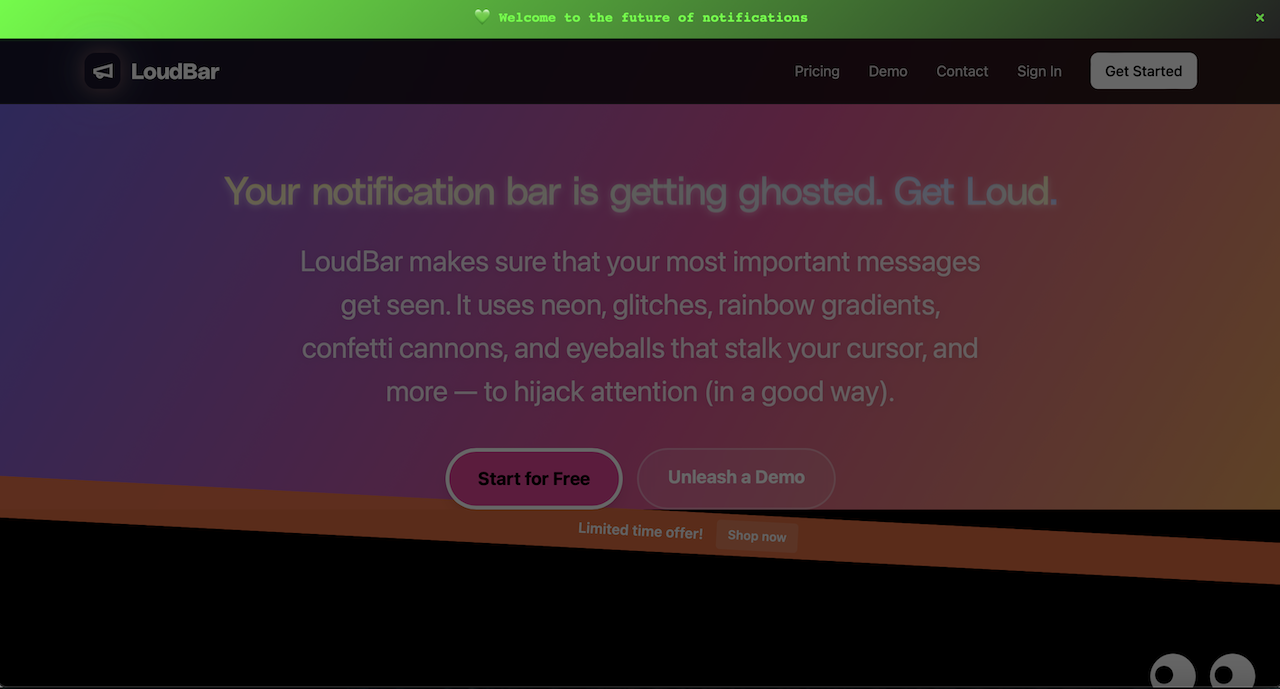
See how it sits cleanly at the top? It delivers a punchy message without blocking the content your visitor came to see.
Practical Triggers for Higher Conversions
The difference between a notification bar that works and one that gets ignored comes down to two things: timing and relevance. A generic message blasted to every single visitor is just digital noise.
A well-timed notification acts as a helpful nudge, not an annoying interruption. By aligning your message with user behavior, you can significantly increase the chances of a visitor taking your desired action.
Let’s look at a couple of real-world scenarios:
- Time-on-Page Trigger: A visitor has been lingering on your pricing page for more than 30 seconds. They’re clearly thinking it over. This is the perfect moment to trigger a bar offering a free consultation or linking to a detailed case study that seals the deal.
- New Visitor Welcome: For someone visiting your site for the very first time, why not roll out the red carpet? Show them a bar with a special introductory offer to make a great first impression and encourage that all-important first conversion.
For each trigger, you’ll want to customize the message and call-to-action. Once it’s live, the final step is to watch the numbers. Tracking click-through rates on your bars tells you exactly how they’re impacting your overall landing page conversion goals, so you can keep tweaking your approach.
For more hands-on ideas, check out our in-depth guides on notification bar customization.
Your Top Landing Page Conversion Questions, Answered
When you dive into landing page optimization, a few common questions always seem to pop up. Let’s tackle them head-on.
Lots of marketers feel stuck on where to even begin. With so many variables—headlines, images, copy, CTAs—it’s easy to get analysis paralysis. If you’re looking for the single change that will give you the most bang for your buck, start with your headline. A powerful, benefit-driven headline is almost always the highest-impact element you can test.
Another big one is page length. Long-form or short-form? The honest answer is: it depends. There’s no magic number. It all comes down to the complexity of what you’re offering and how much your audience already knows. A simple free checklist needs way less convincing than a complex, high-ticket B2B software.
My rule of thumb is this: your landing page should be as long as it needs to be to answer every question and squash every objection, but not a single word longer.
How Many Form Fields Is Too Many?
Ah, the eternal debate over form fields. Everyone knows that fewer fields generally mean higher landing pages conversion rates. But just slashing fields isn’t always the smart move for the business.
Sometimes, asking for more information—like company size or job title—can weed out unqualified leads. Sure, your overall conversion rate might dip, but the quality of the leads you do get could skyrocket.
It’s all about finding that sweet spot between quantity and quality. Before you decide, think about:
- Your Goal: Are you playing a volume game, trying to get as many leads as possible? Or are you hunting for a smaller list of highly-qualified prospects?
- The Value Exchange: People will part with more information for a high-value offer, like a one-on-one demo, than they will for a basic newsletter signup. Make sure the “ask” matches the “get.”
If you’re looking for more practical strategies to solve these kinds of challenges, this guide on 8 Landing Page Optimization Tips for Conversions in 2025 is a great next step. At the end of the day, the only way to find what truly works is to test, test, and test again with your own audience.
Ready to make your most important messages impossible to ignore? LoudBar helps you create attention-grabbing notification bars that boost clicks and conversions. Start turning fleeting attention into action today. Get started with LoudBar for free!